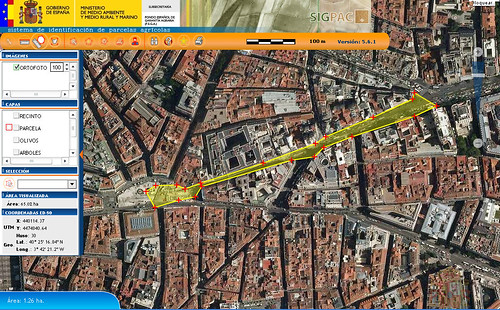
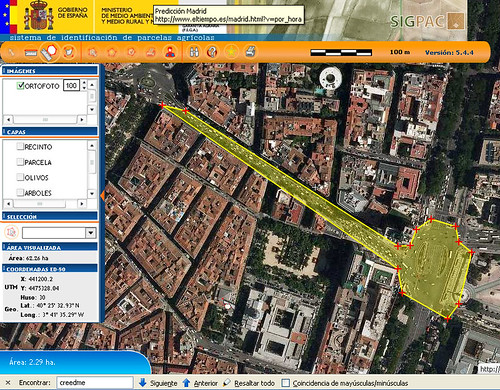
Han pasado casi cuatro años desde que
El Manifestómetro empezó su andadura y no ha cambiado nada. Tras varios puñados de manifestaciones después, la prensa sigue dando la cifra que le sale del ojete, cogiendo con fiabilidad absoluta la que le dan los organizadores o la policía, en lugar de hacer un recuento propio. Si no me falla la memoria, solamente
El País hace sus cálculos sobre el terreno. Dicen las malas lenguas que
Público ha dado alguna vez nuestra cifra (cuando hemos conseguido quitarnos la pereza de la chepa y hemos salido a la calle, que cada vez somos más mayores - unos más que otros, en todo caso - y nos cuesta más levantar el culo de la silla) y posiblemente lo volverá a hacer hoy; o al menos yo estuve ayer hablando con una periodista que trabaja allí. No deja de ser un reconocimiento, que ya es algo. Pero me da que no es lo que buscábamos.
No estoy hablando en nombre de todo el mundo que forma este proyecto; soy sólo una quinta parte del tinglado, pero creo que cuando nació el asunto todo el mundo tenía en mente que, a la larga, con la demostración de que realizar una medida más o menos fiable (con todas las aproximaciones que se quiera, y con pocos medios técnicos - ¿alguien nos deja un helicóptero?) es más sencillo y más corto que cubrir la rueda de prensa de cualquier pesao, los periódicos acabarían haciendo siempre sus propias mediciones. Para medir una manifestación, contando con que se llega en el momento preciso, hacen falta 20 minutos, no más, y habrá dado tiempo a medir dos veces, para asegurarse. Yo llegué a pensar que con el tiempo todo el mundo haría un recuento con datos, que sólo hace falta una decena de fotografías, y todo el mundo podría tener unas estimaciones que no diferirían entre ellas más de lo atribuible al error. Luego me despertaba, parece ser que vivimos en un mundo en el que
la ideología condiciona la realidad, y no al revés.
Termina aquí el inciso.
Al final, en la lucha por la simplificación, se ha llegado a eso que hay ahí arriba. A igualar
una bellota con un roble, a poner argumentos cicateros en carteles y a pasearlos alegremente por las calles.
La cosa no es sencilla:
The question of when a human life begins is a profoundly intricate one, with widespread implications, ranging from abortion rights to stem cell research and beyond. A key point in the debate rests on the way in which we choose to define the concepts of humanity, life, and human life. What does it mean to be alive? What does it mean to be human? Is a zygote or an embryo alive? Is a zygote or an embryo a human being? These are intricate philosophical questions that often incite intense debate, for their answers are used as evidence in the answers to questions about the moral status of a zygote, embryo or fetus.
The question of when human life begins has been pondered throughout history and in a multitude of cultural contexts. The "answer" is fluid, in that it has been changing throughout history, because any answer about when human life begins is deeply integrated with the beliefs, values and social constructs of the community or individual that drew the conclusion. Throughout history there have been several "answers" to the question of when human life begins, but the only consistency among the answers is that they are always changing as social contexts change, religious morals fluctuate, or new knowledge about the process of embryo development is obtained.
No es el propósito de este artículo el ponerse a debatir argumentos a favor y en contra, que es algo para lo que ya ha habido tiempo suficiente, pero sí quiero dar unas pocas pinceladas. El texto que he enlazado arriba es un buen compendio de todos los razonamientos que se han utilizado a lo largo de la historia, incluyendo los presentes en fábulas para camelleros del desierto que aún gozan de aceptación en nuestros días. Leyéndolo, sin embargo, la frase tan repetida de que la vida comienza en el momento de la concepción no se termina de sostener. Que un médico desde la tribuna diga eso, como ocurrió ayer con el presidente de
Médicos por la Vida, es suficiente para ponerme los pelos como escarpias. En consecuencia, voy a permitirme pegar otro par de extractos:
Although the opinion that life begins at fertilization is the most popular view among the public, many scientists no longer support this position, as an increasing number of scientific discoveries seem to contradict it. One such discovery in the last twenty years is that research has shown that there is no "moment of fertilization" at all. Scientists now choose to view fertilization as a process that occurs over a period of 12-24 hours. After sperm are released they must remain in the female reproductive tract for seven hours before they are capable of fertilizing the egg. Approximately ten hours are required for the sperm to travel up to the fallopian tube where they find the egg. The meeting of the egg and the sperm itself is not even an instantaneous process, but rather a complex biochemical interaction through which the sperm ultimately reaches the inner portion of the egg. Following fertilization, the chromosomes contained within the sperm and the chromosomes of the egg meet to form a diploid organism, now called a zygote, over a period of 24 hours. (Shannon and Wolter 1990). Thus, even if one were to argue that life begins at fertilization, fertilization is not a moment, but rather a continuous process lasting 12-24 hours, with an additional 24 hours required to complete the formation of a diploid individual.
The most popular argument against the idea that life begins at the moment of fertilization has been dubbed the "twinning argument." The main point of this argument is that although a zygote is genetically unique from its parents from the moment a diploid organism is formed; it is possible for that zygote to split into two or more zygotes up until 14 or 15 days after fertilization. Even though the chances of twinning are not very great, as long as there is the potential for it to occur the zygote has not completed the process of individuation and is not an ontological individual.
Proponents of this view often propose the following hypothetical situation: Suppose that an egg is fertilized. At that moment a new life begins; the zygote gains a "soul," in the Catholic line of thought, or "personhood" in a secular line of thought. Then suppose that the zygote splits to form twins. Does the soul of the zygote split as well? No, this is impossible. Yet no one would argue that twins share the same "soul" or the same "personhood." Thus, supporters of this view maintain that the quality of "soul" or "personhood" must be conferred after there is no longer any potential for twinning. (Shannon and Wolter 1990)
Luego resulta que el 25% de los embarazos termina en un aborto espontáneo antes de la sexta semana de gestación (
cifra sacada de la Wikipedia, que estoy vago, pero respaldada por
este artículo y
este otro). No sé si
esta mujer es simplemente partidaria de una teocracia como sistema político o realmente cree en dios, pero si lo hace debería tener en cuenta que él es el mayor abortista de todos los tiempos, saque al embrión del útero con caminos inescrutables o no. Más de una de estas mal entendidas vidas humanas habrá terminado en la basura bien absorbida por una compresa: la tecnología de la higiene femenina no respeta ni a las almas.
Otro de los argumentos esgrimidos, el de las consecuencias psicológicas de las mujeres que han abortado,
se va diluyendo cada vez más. Me veo en la obligación de volver a pegar un extracto, del que he eliminado los números que llevan a las referencias bibliográficas para mejorar su lectura; si alguien quiere acceder a los artículos citados, están enlazados en el original:
Abortion and its psychological implications are highly controversial, politically charged issues. Increasingly, scientific research on psychological responses to abortion is being cited as a basis for making policy decisions about access to abortion. In such a climate, it is essential that health providers and policy-makers base their conclusions on reputable scientific research that is methodologically rigorous, conceptually sound and free from ideological bias.
[...]
These studies assessed the psychological reactions of women from 4 weeks to 2 years post abortion or delivery. All of these studies concluded that the emotional well-being of women who abort an unplanned pregnancy does not differ from that of women who carry a pregnancy to term. Reardon and colleagues cite none of these studies. Reardon and colleagues' conclusions also conflict with those reached by a panel of scientific experts convened by the American Psychological Association. On the basis of their review of all studies of psychological responses following abortion that met reasonable scientific criteria, this panel of experts concluded that first trimester abortion generally is "psychologically benign" for most women. The surgeon general of the United States reached a similar conclusion.
A su vez, la adopción
tampoco está exenta de problemas. No puedo seguir enlazando artículos sin poner la nota cómica (si acaso lo fuera) con el famoso artículo
The Impact of Legalized Abortion on Crime, cuyo coautor es
Stephen Levitt, autor de Freakonomics, que estableció una relación causal entre la legalización del aborto en varios estados de Estados Unidos en 1970 y una caída de los índices de criminalidad en esos mismos estados durante los 90. Tampoco ese artículo está libre de críticas, por supuesto.
En última instancia, algo que parece olvidado, es que esta ley no establece un aborto obligatorio. Nadie está obligado a abortar, que sigue siendo una decisión última de la mujer embarazada, que decidirá si quiere llevar ese embarazo a término o no. Es necesaria una ley que asegure que la mujer que decida abortar pueda hacerlo en unas condiciones sanitarias aceptables, y no en el lavabo de casa con una percha.
Al final, todo parece cuestión de retórica y de apropiarse palabras. Ha llegado un momento en el que, al oír
en libertad o
valiente, mi cerebro traduce automáticamente por
sin complejos o
facha redomado. Tras retorcer el lenguaje a extremos que me han llevado a leer
imponer el aborto libre, tal y como suena, empiezo a pensar que gran parte del argumentario de ayer se traduce en el dibujo de un niño en el lateral de un autobús perteneciente a esta misma gente que dice estar en contra del adoctrinamiento infantil:
(Más imágenes de la manifestación en este set de Flickr. Este artículo se publica simultáneamente en El Manifestómetro y en Las penas del Agente Smith.)